
It is a fearful thing to fall into the hands of the living God.
Hebrews 10:31

It seems like during the covid quarantine I heard the term “cost-benefit analysis” more than ever before. A cost-benefit analysis is really just a fancy pros and cons list, sometimes put together in retrospect. In business I guess it’s pretty straightforward– did we make more money than we spent? With covid it was more subjective, and there was more at stake– saving lives v. allowing people to live their lives.
There’s a famous theological cost-benefit analysis known as “Pascal’s Wager.” Blaise Pascal was a 17th century mathematician, philosopher, physicist, and engineer. But he was also a theologian. His “wager” was that if you believe in God and you’re wrong, you haven’t really lost much. But if you don’t believe in God and you’re wrong, there’s a very high price to pay. According to Pascal, the safe bet is to bet on God.
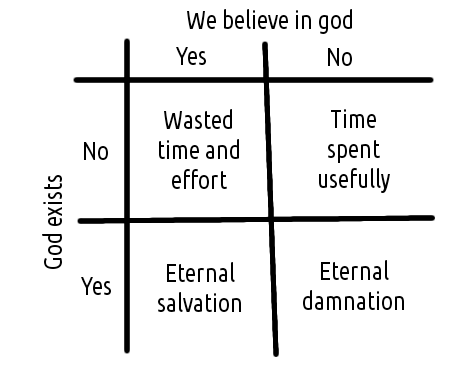
Even though Pascal is right in his conclusion, I’m afraid that living the Christian life just to hedge your bets is not quite what Jesus had in mind when he said, “Take up your cross and follow me.” What the chart above fails to mention is that “all who desire to live godly in Christ Jesus will suffer persecution,” (2 Timothy 3:12). A cost-benefit analysis needs to “count the cost” accurately. So is God a “safe bet?”
In C.S. Lewis’s The Lion, the Witch, and the Wardrobe, Mr. Beaver says of Aslan, who is a type of Christ: “Course he isn’t safe; but he’s good…. He’s wild, you know. Not like a tame lion.”

There has been a lot of debate around this as a description of God. Ellen Mary Dykas of harvestusa.org wrote a brief article, “Daring to Disagree with C.S. Lewis,” in which she argued against expressing God’s “wild” side as “not safe.” She is a counselor for those caught up in sexual sin and sexual abuse. For abuse victims this is an important reassurance, that God is safe.
But John Eldredge, in an important book called Wild at Heart, says “there is something fierce in the heart of God.” Eldredge makes a distinction between how Jesus acted toward the hurting, the outcast, and the unclean who couldn’t even be touched versus how he reacted to pompous, hypocritical, self-righteous Pharisees, for example. He also points out how the God of the Old Testament struck down entire peoples. He even punished his own people.
The things men and women do to each other and the ways people rebel against God sometimes offend Him to such a degree that in Old Testament times He was willing to wipe them out. God is not tame.
Therefore consider the goodness and severity of God: on those who fell, severity; but toward you, goodness, if you continue in His goodness. Otherwise you also will be cut off. (Romans 11:22)
Later in Romans 13:3, Paul said something of human rulers that can also be applied to the Supreme Ruler:
For rulers are not a terror to good works, but to evil. Do you want to be unafraid of the authority? Do what is good, and you will have praise from the same.
God is a safe refuge for the faithful, but he’s a terror unto evil.
A proper cost-benefit analysis has to take all the known factors into consideration. Even then, there are few guarantees or certainties. People still debate whether the covid lockdowns were the right call. A business decision may be proved clearly right or wrong only after the fact, after the capital has been risked.
When weighing the pros and cons of serving God, we must acknowledge that living the Christian life is not always safe. The apostles would have been much safer, physically, if they had just gone back to Judaism.
But Pascal was right about one thing— the cost of not serving God is unthinkably high. And as Paul said in Romans 8:18, “the sufferings of this present time are not worthy to be compared with the glory which shall be revealed in us.”
God may not be in every sense “safe,” but He’s always the right choice.
Dear God, sometimes I am tempted to avoid the hard things about serving You. Please keep me in Your word to remind me that the path and the end of the sinner are much harder. Continue to bless me as You see fit, giving me what I need to stay faithful to You. Help me always to remain in the safety of Your good favor. In Jesus’s name, Amen.
by Christie Cole Atkins
Dykas, Ellen Mary. “Daring to Disagree with C.S. Lewis: The safety of God.” (December 13, 2008) Harvest USA.
https://harvestusa.org/daring-to-disagree-with-cs-lewisthe-safety-of-god/#.ZEO9hxXMLDI
Eldredge, John. Wild at Heart (2001, 2010). Thomas Nelson. Nashville, TN.
Also, with some trepidation, I’m going to put this right here. You’ll either love it or hate it:
 Walk Worthy
2 responses to “Is God Safe?”
Hi Christie, you really make me stop and think!! Consequences – all the decisions I make have consequences. Thank you, as always.
Our wonderful Heavenly Father only wants our good. He has given us evidence of His existence by the very creation of man and all that’s in nature. His wisdom that He shares in His Scriptures is just as true today as it was when it was recorded. His wisdom can guide us through life and make our lives on this earth better.
Sin and persecution makes our lives harder and can physically and emotionally destroy us. The evil He revealed in the Scriptures is just as evil today as it was when it was recorded.
God allows us all to have a “free will” to make our own decisions. I choose to love the Lord my God with all my heart, soul, mind and strength. I choose to study, know and do my best to follow His wisdom and trust Him with all of my heart. He is so amazing!!! I want to spend an eternity with Him.
LikeLiked by 1 person
Christie gettin’ all scholarly!
Good one.
>
LikeLiked by 1 person