

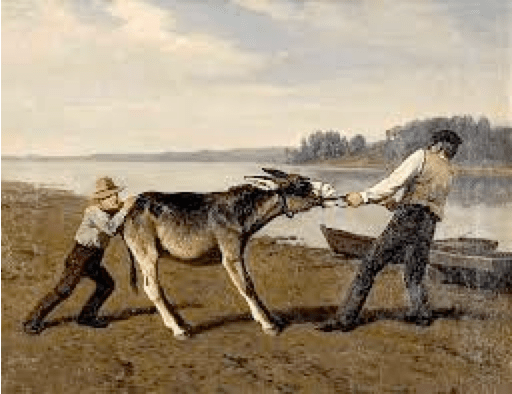
Do not be like the horse or like the mule,
Which have no understanding.
Psalm 32:9a
I’m a cat person, and it’s obvious to me that cats understand everything we say. They’re just ignoring us. It’s what cats do. But generally speaking, animals, even intelligent ones (like cats), do not have what we would call “understanding.”
God has given human beings the ability and the means to gain understanding, yet He doesn’t force it on us. If we choose to ignore our spiritual side and our spiritual resources, we will end up living like animals without understanding, slaves to our instincts, seeking only our own physical comfort and pleasure; bucking and kicking, biting and scratching, when we can’t get what we want.
I recently read an article by John Piper that raised this question: if the people who crucified Jesus didn’t know what they were doing, why did Jesus pray for their forgiveness? How could they be held accountable for something they didn’t know? Piper proposes that it was their very ignorance that needed forgiving because they could have known they were killing the Son of God. They should have known they were killing the Son of God. God had given them the ability and the means to know that crucial bit of information. But their hearts were hard. They would not acknowledge the truth.
Yet Jesus prayed for their forgiveness. While he was hanging on the cross in the midst of death agony, he was asking for their forgiveness.
Then Jesus said, “Father, forgive them, for they do not know what they do.” Luke 23:34a
And his prayer was eventually answered, at least partially. In Acts 2, when Peter accused his audience of having crucified the Son of God, “they were cut to the heart, and said to Peter and the rest of the apostles, ‘Men and brethren, what shall we do?’” (Acts 2:37). They didn’t argue that they should be excused because of their ignorance. They didn’t try to blame others. They had killed him and they knew it. They had reached a point of understanding. Many of them were baptized into Christ that day, among the first Christian converts. Jesus had prayed for their forgiveness, and now they were receiving it.
Of course not all of those responsible for Jesus’s death repented. As we read on through Acts we see the pattern repeating time after time: some people believed and some didn’t. Some were mildly curious, and some vehemently persecuted this new “sect.” For believers, it didn’t matter much. They “went everywhere preaching the word,” (Acts 8:4). When persecuted, they rejoiced “that they were counted worthy to suffer shame for His name,” (Acts 5:41). Even Stephen, who became the first Christian martyr when they stoned him to death, imitated Christ in praying for his persecutors to be forgiven (Acts 7:60). (Eventually his prayer was answered, at least for one man, Saul of Tarsus.)
When we pray for our enemies, we are not asking God to ignore their sin. We are praying for their understanding; that eventually their eyes will be opened, their hearts will be softened, and they will come to Jesus so they can be forgiven.
I’ve heard it said that it’s hard to hate someone for whom you are consistently praying. Praying for our enemies goes against our instinct. But we’re not animals. We don’t have to follow our instincts. We have the ability and the means to know God’s heart on the matter. Jesus taught us to pray for those who spitefully use us (Luke 6:27), and he lived it out on the cross.
He prayed for his enemies to be forgiven. On the Day of Pentecost in Acts 2, some of them were. And every time one of us chooses to come to God for forgiveness on His terms, that prayer of so long ago, “Father, forgive them,” is answered yet again.
For if when we were enemies we were reconciled to God through the death of His Son, much more, having been reconciled, we shall be saved by His life. Romans 5:10
Dear God, sometimes I can be so stubborn, closing my eyes to the truth. Please forgive me and help me in turn to be forgiving toward others. I pray for understanding, and I pray for my enemies as Jesus prayed for his, even for me. I thank You and praise You! In Jesus’s name, Amen.
by Christie Cole Atkins

Related Reading:
John Piper’s article: Father, Forgive, For We Know What We Are Doing
 Walk Worthy
One response to “Father, Forgive Them”
[…] Father, Forgive Them […]
LikeLike