

For though I am free from all men, I have made myself a servant to all, that I might win the more; and to the Jews I became as a Jew, that I might win Jews; to those who are under the law, as under the law, that I might win those who are under the law; to those who are without law, as without law (not being without law toward God, but under law toward Christ), that I might win those who are without law; to the weak I became as weak, that I might win the weak. I have become all things to all men, that I might by all means save some.
1 Corinthians 9:19-22
The apostle Paul had a great education. Taught at the feet of Gamaliel, he knew all about the history, cultures, and customs of the different people he taught on his missionary journeys. He used that understanding to relate to them in hopes of reaching them with the gospel. He said, “I have become all things to all men, that I might by all means save some.”
It’s wise to look for common ground when you’re trying to share the gospel.
Last week I talked about how understanding different personality types can help us get along with people. It can also help our evangelism efforts much like Paul’s understanding of cultural differences helped his. After all, different people are motivated (as well as de-motivated) by different things. Understanding personality types can help a Christian to more effectively pique another person’s interest in the gospel, as well as to avoid pushing them away unnecessarily.
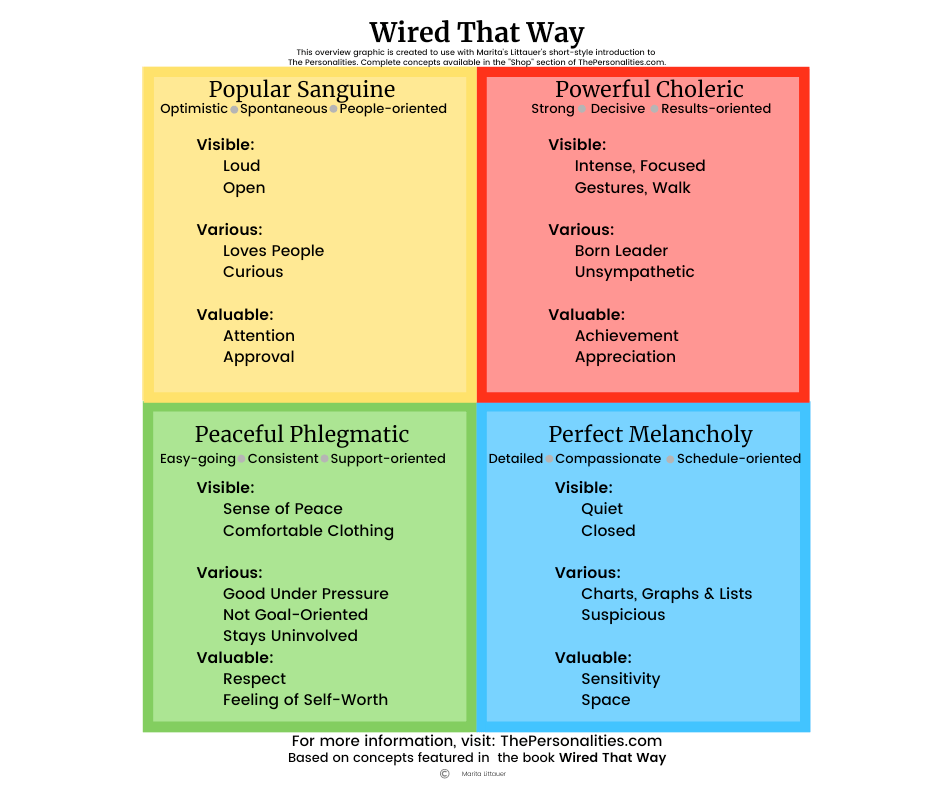
There are several personality typing systems. I’m certainly not familiar with all of them. But one I have found helpful in all kinds of relationships is the Personality Plus series by Florence Littauer. I like this one because there are only four “types” and, once you learn them, they’re easy to keep in your head. (Her daughter has re-booted this system in recent years with a book entitled Wired That Way and a website: http://www.thepersonalities.com.)

As you look at the graphic at the top, you might notice the personalities are named after the four classic “humors,” but no one in modern times is saying that our differences are a result of varying amounts of blood or bile in people’s systems. (Gross!) Littauer has only borrowed this classic terminology. (And if you’ve never heard of this, don’t worry about it.)
The most familiar word of the four is “melancholy,” but don’t be fooled by that either. The melancholic personality isn’t just sad and pensive all the time!
As I said last time, any given personality trait can be an asset or a liability. For example, the Melancholy tends to follow rules and sometimes seeks to enforce them. As an administrator or leader, this is important. But taken to an extreme, this trait can be oppressive.
On the other hand Sanguines tend to be loose with the rules. Of course, if you’re too loose with the rules, it could get you fired or land you in jail. But familiarity with Personality Plus helps me, a part-melancholy, to understand and appreciate how Sanguines bring fun and spontaneity to the world.
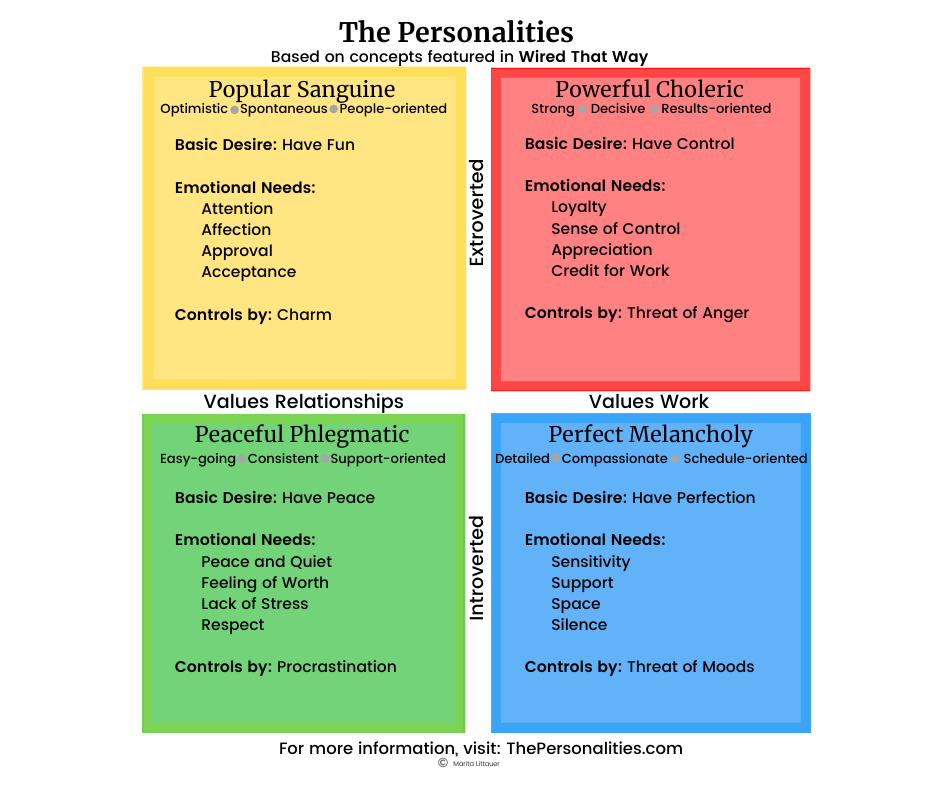
Understanding of personality types can help us be more appreciative of those who handle things differently than we do, but how does it help us in sharing the gospel? Well, for example, if you were to come at the Peaceful Phlegmatics with a hard-hitting lesson on the importance of obedience, they might feel overwhelmed and tune you out. It’s probably better to introduce them to “the Prince of Peace,” and teach them how He gives us the strength and power to do things we didn’t think were possible.
On the other hand, you may bore the Cholerics with that approach. They are more likely to be moved by the picture of the Perfect Father who is the perfect leader in every way, one who challenges us and improves us.
A word of caution: personality typing systems have been criticized by some Christians who consider them “new age,” or who have concerns that people could treat them as doctrine. Certainly they are no replacement for the gospel. And trends in psychology can indeed run counter to Christian belief. But that doesn’t mean that psychology isn’t a real thing or that personality differences are imagined.
My personal opinion is based on my personal experience and that is all, but I have found the study of personality types to be interesting and helpful for better understanding myself and for understanding and getting along better with people in my family, church, and community. Still, I think the most sublime reason to learn about personality types is that it just might help us to become “all things to all men” that we might save some.
Dear God, I praise You for how You have created each individual person to be uniquely special. I also thank You for patterns and similarities that can help us to understand how to relate to one another. Grant me the wisdom to understand myself better and the humility to do all I can to get along well with others so that I might influence them with the gospel. In Jesus’s name, Amen.
by Christie Cole Atkins
 Walk Worthy