


A son honors his father,
And a servant his master.
If then I am the Father,
Where is My honor?
And if I am a Master,
Where is My reverence?
Says the LORD of hosts
To you priests who despise My name.
Malachi 1:6

Have you ever noticed in a lot of stories there’s a motif of a bad guy whose name you can’t say? I’m thinking Voldemort, Sauron, Bruno…. Usually some courageous protagonist challenges the taboo, speaking the name boldly, thereby breaking the spell of fear to some degree. (Or as with Bruno we find out he’s not a bad guy after all!)
At the other end of the spectrum, in traditional Judaism the name of God is never spoken or even written out completely. This is also done out of fear– the fear of accidentally breaking the third commandment: “You shall not take the name of the LORD your God in vain, for the LORD will not hold him guiltless who takes His name in vain,” (Exodus 20:7).
This is why you’ll sometimes see “G-d” and it’s also why, in the Old Testament, you’ll see LORD in all caps in place of the original YHWH.
But that is only a tradition. Speaking the Lord’s name is not forbidden in the scripture. But swearing by His name is (Matthew 5:33-37). My personal observation is that the people who swear the most strongly, like on their mother’s grave and such, usually seem the least trustworthy.
Furthermore, in Proverbs 30:8-9 the writer says, “Give me neither poverty nor riches…lest I be full and deny You, and say, ‘Who is the Lord?’ Or lest I be poor and steal, and profane the name of my God.” We certainly don’t want to deny God or profane His name through shameful behavior!
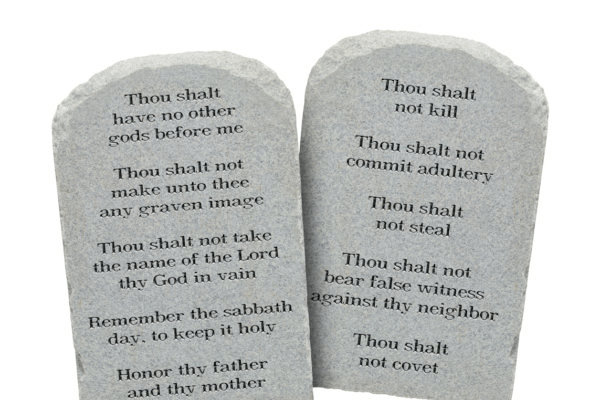
But taking the Lord’s name in vain also profanes it. And I think we do it in ways we don’t even realize, myself included.
First of all, vain means, in this case, empty. To take someone’s name in vain is to empty it of its meaning or of its true qualities. Now, consider the many names and titles given to the Messiah:
“His name will be called Wonderful, Counselor, Mighty God, Everlasting Father, Prince of Peace,” (Isaiah 9:6).
“And Jacob begot Joseph the husband of Mary, of whom was born Jesus who is called Christ,” (Matthew 1:16).
“He has on His robe and on His thigh a name written: KING OF KINGS AND LORD OF LORDS,” (Revelation 19:16).
If we speak any of these names in a way that empties them of their meaning and glory, we are taking them in vain. Now I’ve never heard anyone exclaim, “Counselor!” after stubbing their toe or “Prince of Peace!” when something surprises them. But we all know some of these names are frequently used in vain to express frustration, surprise, disdain, or even as a curse word. I think we can do better. God expects us to hold His name in reverence.
We are commanded to “give the Lord the glory due His name,” (Psalm 29:2; 96:8). The opposite would be to empty His name of its glory, to profane it.
The Lord’s model prayer in Matthew 6 teaches that the Lord’s name is hallowed, holy, set apart. It’s not there for vulgar or even careless usage.
This reminds me of a sermon I heard when I was a teen. It was about avoiding euphemisms. (Yes, I learned a new word that day.) The preacher argued that even saying words like gosh in place of God, or dang in place of you-know-what is really just as bad because it calls the inappropriate word to mind. After all these years I’m still not sure whether I agree. But after that lesson, for a long time if we wanted to express shock, my best friend and I would exclaim, “Great Scott!” I still think of that sometimes and smile. I’m not sure that was the best solution, but our intentions were good.

I think Gandalf and Harry had it right. We need not be afraid to speak a villain’s name. Fear is a type of reverence and though we should have a healthy respect for the damage villains like Satan can do, they are certainly not worthy of reverence.
When we speak God’s name, we should fear to speak irreverently, profanely, or in vain. He is the only one worthy of reverence. Hallowed be His name.

Heavenly Father, please help me to develop the proper reverence for You, for Your name, for Your Son, and for Your Holy Spirit. Forgive me for the times I have emptied Your name of its glory by using it thoughtlessly. Help me always to live and speak in a way that honors You. Thank You for Your grace, mercy, and forgiveness. In Jesus’s name, Amen.
by Christie Cole Atkins
For a deeper look at this topic, I highly recommend this article by well-known teacher and preacher, John Piper: https://www.desiringgod.org/articles/how-we-take-gods-name-in-vain
 Walk Worthy
One response to “Names You Can’t Say”
This lesson makes you think about how you say something thanks Christie
LikeLiked by 1 person